The Goddesses & Gods of India
Decoding Hindu Iconography
While the previous article was on Dharma and identity, I am attempting to write here on Hindu Iconography & Symbols. Recognising relevance of Icons in the modern context form part of realising and reviving our identities. Hindu art is creative and expresses the spiritual view of the land of ancient India. On that note, I believe you will enjoy this article.
The science and art of ancient Hindu symbolism
and iconography were sophisticated and complex. While the ancient Indians were
creative in their expression, the idea of icons expressing and communicating concepts
and spiritual ideas of the civilisation is all but lost in modern India. There
is an increasing disconnection between the current generation of Indians and the
forms of ancient Hindu art, symbols, sculpture & architecture.
The disconnection could be associated to
various factors not limited to an education system that is designed to erode
away any appreciation of the country’s own civilisation & culture, lack of
interest in studying art due to a mindset that education is solely seen as a future
financial investment, political, lack of parental motivation, to name a few. The
intent of this blog is to make an attempt to analyse these symbols thoroughly
and extract the underlying principles and concepts so that the symbols and
icons are seen as truly relevant to modern Indians.
Terminology:
So, why the word Icon and not Idol ?
Icon (derived
from the Greek word eikṓn) is a religious work of art generally used in the Christian
cultures. It is a sacred religious symbol used for religious devotion.
Idol, on
the other hand, is a derogatory word used by Europeans to describe Hindu Gods
& Goddesses. Idol derived from
the Greek word eidolon or phantom
(illusory / not real) and symbolises something that is misleading or mysterious.
Therefore, if you must use English terminology, I suggest use of the word Icon.
In Sanskrit, however, a few words for an
‘Icon’ are:
Bimba = reflection
Vigraha = expansion,
extension or form
Bera = image
Pratimā =
representation, resemblance
Mūrti =
anything that has definite shape and physical limitations, an embodiment or an
incarnation (etat sarvam yanmūrtam
cāmūrtam ca tasmān mūrtir eva rayi:) - Prashnopanishad
Pratīka = symbol
Rupa = an aggregrate
form
Arca = an object of (devotional)
adoration and worship
Purpose of Icons:
Human interaction and understanding occurs
through symbols. Words themselves are symbols that have a deep symbolic
significance used to communicate (reference).
We use symbols every day to convey ideas such as its growing use in chats such
as Whatsapp, Skype, etc. Ancient Indians as well developed sophisticated forms
of symbols to communicate ideas, principles and forces that sustain the cosmos.
These fundamental attributes of the cosmos and their presiding consciousness
cannot be perceived, however, they are certainly experienced and the icons are
the symbols of those experiences. Examples of these principles are, to name a few:
creativity, the potential for logic and reasoning, love, action, anger, greed,
ego, success, intellect, achievement, loss, wealth, prosperity, pollution, etc.
While love cannot be perceived (even by
the experiencer), it can, however, be represented with a symbol of heart - the
heart being the symbol to communicate the feeling of love. Needless to say, one
cannot deny the principle of love so as well one cannot deny the symbol that
stands for love. Therefore, as long as the feelings are real and the symbol that
represents the principle as well indeed real.
In order to remind the society of the forces and principles of nature and to interact with this potentials a form / categorisation (ākāram) is given. The Vedas reveal that the entire universe comprises of categories - name (nāma) and form (rūpa) - anena jīvena ātmanā anupravishya,
nāma rūpa vyākaravāni (Chāndogya Up.). Therefore, the purpose of the icons is to establish a form to interpret the experience of the divine forces and to communicate that to others.
Let me further explain with two examples
to understand the language of Iconography symbolising the presiding deities. I
have carefully selected these two examples below based on applicablity of human
experiences. They have straightforward relevance to all.
I believe the reader, regardless of your
sampradāya or lineage or tradition, will be able to relate to the below
reasoning behind the icons from a larger Hindu audience. My appeal and attempt
is certainly not sectarian and is for all Hindus and as well those interested in Hindu iconography
to unite, understand and appreciate the deeper concepts of Hindu art, culture,
its practices and tradition. However, you will note that these symbols apply to
all beings and not limited to Hindus.
I will expand further on both Pancaratra and other Hindu iconography
and symbolism in future blogs when time permits to the best of my ability.
1. Lord Ganesha
In order to understand the icon one must
first understand the idea packed in the Sanskrit word used for the icon.
Etymology: Ganesha = Gana + Esha
Gana =
Logics, Maths (Ganita), categorisation, and
Esha
= the Lord of that principle
Therefore, Ganesha
= The lord of all principles of logics and categorisation
Within every living being (humans,
flora, fauna and even microorganisms) there exists potential of logic and
categorisation. We categorise all the time and in every moment – males,
females, adult, child, tall, short, wood, wall, brick, black, white, colours, vehicles,
property, wealth, pleasure, pain, so on and so forth.
Every being carries a potency of the
principle of logic and is able to categorise. The sum totality of the principle
is called Lord Ganesha. For logic to manifest it needs the mind
(manas) and this is where the vāhana (vehicle ) mushika – rat of Lord Ganesha
is a valuable addition for us to comprehend.
So, what does the rat represent? Think
of how the rat behaves. It moves in corners and sticks to dark and dirty places.
The mushika (the rat) is representative of our minds which has a tendency to
move into dark places if not checked – i.e. being negative, pessimist, cranky,
moaner, etc. Lord Ganesha or the principle of logic (within us) has the
potential to overcome the negative mind in a given situation.
The Icon of Lord Ganesha along with his
vāhana (vehicle) also symbolise that of all obstacles the major obstacle is our
own mind, therefore, Lord Ganesha being the principle of logic is able to categorise
(recognise) the negative mind and having recognised , therefore, assist you in applying
necessary controls to overcome the negative mind and perform your actions
skillfully. He is also said to be the remover of all obstacles. Obstacles that primarily
originate in our own mind due to its negative tendencies and as well from
outside through other beings or situations.
He has two consorts
– Siddhi and Buddhi.
·
Siddhi = Success
·
Buddhi = Intellect
In summary, the derived meaning of Lord
Ganesha along with his consorts is: The mind must apply skillful reasoning (logic
+ categorisation) in a situation using intellect (Buddhi) to perform an action skillfully then there is potential for
success (Siddhi).
In northern India, Riddhi is said to be a third consort
Riddhi = Progress
Once there is Siddhi (continuing from above) which is success in life projects or in situations we face, there is progress (riddhi) in life. All aspects of icons represent basic function of life as a cosmic principle.
2. Kāma devā
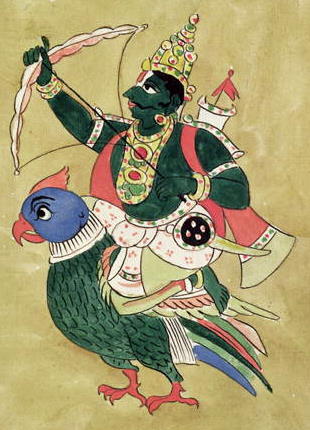
The icon of Kāma Devā is said to be a
handsome man riding a parrot with a bow made of sugarcane, strung with humming
bees and shoots floral arrows. His consorts are ratī and prīti.
Kāma =
desire
Devā =
Lord
He is also called manmathan – the churner of the mind or the one who agitates the
mind
He is the Lord of Desires or He can be
said to be the presiding principle.
Let us take, for example, love as a form
of desire. Love is sweet (represented by the bow made of sugarcane) at the same
time it can hurt (reminded to us by the bees – if the bee stings it hurts).
5 x floral arrows = fascination (unmada), distress (tapana), draining (shoshana),
stiffening (stambana) and infatuation / delusion (sammohana).
His consorts:
Ratī = the
principle/potential of lustful desire
Prītī
=
the principle of kind, graceful and devotional love
In our lives, we note
both these types of love driven by desires.
Ratī being the lustful / erotic love,
and
Prītī being the compassionate and
devotional love towards parents, elders, our children and other family,
friends, birds and animals.
Do
Gods & Goddess exist?
Given that the Hindu Gods &
Goddesses are the principle forces of nature that we experience daily, the answer
to the above question is easy – YES of course they exist. If we deny their
existence then we deny the very concept of our living and our daily life
experiences itself. The applicability (principles of nature) is not just to humans but to common to all living beings.
They exist as the presiding potentials
and principles that cannot be perceived but experienced and not literally as
the icons and symbols we use only to understand these cosmic principles.
Arguing over existence of a physical form of an Elephant headed god or a Monkey god are worthless because it is a representation of a priceless ideal that has benefits passing down the evolutionary chain.
The representations of the principles give us advantages over other living beings that lack the same and so Hinduism is a system of passing down ideals and not belief in imaginary overlords that grant wishes and punish the rule breaker.
It is said:
आहार निद्रा भय मैथुनं च समानमेतत्पशुभिर्नराणाम् ।
ज्ञानं नराणामधिको विशेष: ज्ञानेन हीनाः पशुभिः समानाः ॥
Āhāra nidrā bhaya maithunam cha samānam_etat_pashubhir_narānām |
jñānam narānām adhiko viśeśa: jñānena hīnā: paśubhi: samānā:
Food, sleep, fear and procreation, these acts of humans are similar to animals. It is applied knowledge (wisdom & skillful action) alone that is special to humans, without that applied knowledge humans are as well animals.
Protection
from & interaction with Gods & Goddesses:
In the Mahabharata, the minister Vidura
says to King Dritarāshtra of Hastināpur the following:
न देवा दण्डमादाय रक्षन्ति पशुपालवत् ।
यं तु रक्षितुमिच्छन्ति बुद्ध्या संविभजन्ति तम् ॥
na devā dandamādāya rakshanti pashupālavat ।
yam tu rakshitum ichchhanti buddhyā samvibhajanti tam ॥
It is said that when the forces of
nature (Deva – the gods) want to protect one, they DO NOT protect like a shepherd with a stick but provide the person with
intelligence to reason in order to skillfully overcome situations, challenges
and hurdles.
To reiterate again the above examples
(not in extreme detail) are a taster. In my next blog, I will attempt to take a
deeper dive into Sri Vishnu tattva of Pāncaratra āgama.
